Friday, August 22, 2008

Update on the Pro Jr. Project

I’ve received several emails with good suggestions for the tube and speaker swaps in the Fender Pro Jr harp amp project.:

-12AY7 in V1 (suggested several times)
-12AU7 in V1
-12AT7 in V2
-12DW7 in V2

(V1 is the preamp socket; V2 is the phase inverter)

-Jensen C10Q reissue speaker

-Weber 10 Sig alnico straight cone speaker
-Weber 10A150 speaker

I emailed Ted Weber and he suggested a 10F150-O, but that costs 90 bucks and I’m trying to keep this project down to a moderate level. I’m still looking around for an interesting used speaker. If nothing turns up I’m leaning toward the Weber Sig ceramic with straight cone. I use that speaker in my 2x10 cab and I know it sounds great with harp.

I ordered a NOS JAN Philips 5751 preamp tube from Tube Depot in Memphis. On a whim I visited my friend Al in his tube heaven junk store and found an old used Sylvania 12AY7 with some corrosion on the pins. I’ll try and clean it up and see how it sounds.

In the article about my Fender silverface Champ project I dug into the issue of the Negative Feedback Circuit in Fender amps and how it affects harp tone. The NFB circuit in the Pro Jr. is a violet wire that extends from the middle of the circuit board to the speaker jack. I’ll unsolder or clip the wire and tape it off. Some players install a switch or pot in the circuit to adjust the NFB, but with the Champ project I discovered that zero NFB is best for my tastes.

I had heard that the green filament heater wires in the Pro Jr are not twisted and are routed along other wires that could easily pick of noise from them. In my Pro Jr. they aren't twisted, but they are dressed pretty well, crossing other wires at a 90 degree angle. The amps does not seem noisy so I'll leave well enough alone.

The Pro Jr. has a bleed circuit that drains the amp of any power within a few seconds of shutdown, which is supposed to keep you from getting shocked. Still, I short the no. 1 pin of the V1 tube socket to ground for extra caution before working on the guts of any tube amp. I suggest you do the same.

Jump to Fender Pro Junior Harp Amp Project – Speakers

Friday, August 15, 2008

Review: Danelectro Fab Echo pedal


First of all, this pedal sells for $14.99, about a tenth what you would expect to pay for a decent delay pedal. That, and a smattering of positive reviews from guitar players got my attention.

The Fab Echo is not long on features, of course. But it does one thing rather well… it has a nice warm slap-back that works well for harp.

Harp players argue constantly about which delay pedal is best: Analog or digital? Maxxon, Ibanez, Boss, or Digitech? If you are a Chicago-style blues player – if you lust after Little Walter’s tone – all those delay pedals have way more features than you will ever need. What sounds good for traditional amped blues harp is a touch of greasy slap-back echo. That’s all.

And that’s where the Danelectro Fab Echo comes in. It has two controls, Repeat and Mix. The repeat knob controls the number of echos, with a single echo at the minimum position. That is what we want for harp. The other knob controls the output mix of dry and wet signals, from all clean to all echo. Essentially, this is s a one-knob pedal for harp players.

What you pay all the extra money for in other delay pedals is the Delay Time control, which is conspicuously missing from the Dano Fab Echo. But if you only use one echo – a “slap-back” – then the lack of a Delay Time control is pretty much meaningless.

I recorded three very brief sound clips to give you a basic idea of how the Dano Fab Echo pedal sounds for blues harp. The first clip has the Repeats control at the minimum (one slap) and the Mix control at the max (all echo, no clean). This clearly illustrates the delay time built into the pedal, but you sure would not want to use it this way.

Clip 1

The next clip has a similar riff, with the only change being the Mix control is at 50 percent. The pedal sounds best to me at this setting

Clip 2

For reference, here is a very short clip with the pedal switched off.

Clip 3

How do you think the Dano pedal sounds? For its price and simplicity I think it sounds good, but lately I have preferred playing dry… no reverb or delay at all. But, Crikey! For chump change you can have a usable no-frills slap-back pedal in your bag of tricks. At the very least it makes a great back-up if your fancy delay pedal (most of whose features you never use) ever craps out.

Observations:

This pedal is made of plastic, but it is hefty and feels solid. The jacks are soldered onto the circuit board but don’t feel loose or cheesy. Product support at Danelectro is known to be pretty much non-existent, but if it breaks, what the heck. Just buy another one.

This pedal is not noticeably noisy. The pilot LED is a brilliant blue. The controls are a little confusing at first because they face away from you as you look at the pedal. It has a 9V power connector so you can use a common power adaptor instead of hassling with batteries.

I ordered it on a Monday evening from Musicians Friend online, and it arrived at my house in Denver via USPS express mail on Thursday morning.


Test Notes:

I used a OneSpot adaptor to power the Dano pedal. The amp was a vintage
Masco ME-18 and 2x10 cab. The recorder was a Zoom H4. Instead of mic’ing the amp, I used the H&K Red Box Pro DI to avoid room effects. The harp mic was a Peavey H5 Cherry bomb with Shure CM element. The harp was a Hohner Marine Band Deluxe in the key of B-flat.

Thursday, July 31, 2008

Gary Smith/Aki Kumar - Rocket Ride


Here is a great vid of Gary Smith (on the right) playing a harp duet with Aki Kumar, an excellent young player.

Both these guys are playing through Sonny Jr. amps: Gary is using his Cruncher and Aki is using his SJ410.

Nice tone...

Wednesday, July 23, 2008

Gary Smith endorses the Sonny Jr. Cruncher Amp

Gary Smith, whose legendary tone earned him the title of Godfather of the South Bay Blues, has endorsed the Sonny Jr. Cruncher amp. This is a very big deal for a lot of reasons.

I had heard about this endorsement but I was skeptical. Gary has always been a vintage Fender guy. In fact, his award winning DVD “
Amplified Blues Harp Demystified” is mostly a celebration of the magic of vintage Fender amp tone. For Gary to get behind a different amp now is, as I said, a very big deal.

Anybody who has heard Gary Smith play live or has heard his CD “
Blues For Mr. B.” or on Mark Hummel’s “Blues Harp Meltdown” knows that Gary has the most beautifully articulated Chicago-style tone on the planet. Listen to the first few bars of You Can’t Hurt Me No More or Elevate Me Mama for an object lesson in blues harpology.

That is why this is such a big deal. Gary honed his extraordinary tone over the last 40 years using mostly Fender gear. His main gig rig of late has been the venerable Fender Bassman. For him to change up now is a huge risk of upsetting the perfect tonal apple cart. He had to be mighty impressed with the Cruncher amp to do this.

He is. I had a conversation about this with him last night. Gary Smith fully endorses the Sonny Jr. Cruncher amp, and will be using it at all his gigs. In larger venues he will add the Bassman for back-end support while mic’ing the Cruncher through the FOH speakers. At all other gigs it will be the Cruncher by itself. What he likes about the Cruncher is the complex tone from the multiple speakers of different sizes and configurations. He told me the Cruncher throws to the back of the room with ease. He walked around while another player used his un-mic'ed rig and said it sounded “right there in the front of the mix.”

As you may be able to tell, I am very impressed with Gary Smith as a blues harp player. He is the real deal, and he is an expert on harp amps. If he sincerely endorses the Sonny Jr. Cruncher – and I am convinced he does – then that is good enough for me. Yes, I have had my differences with Gary Onofrio, the owner of the Sonny Jr. brand, but this is impressive and cannot be ignored. Also, Onofrio was a stand-up guy in helping me hook up with Gary Smith.

Sound clips of Smith playing the Cruncher are on the way and will be added to this post soon. I’m still working to get a Cruncher amp in my hands for a thorough review. Check back for more details on this.


Sonny Jr. Amps

Wezo Megatone Amp

Mike Wesolowski sends along photos and a spec sheet for his very interesting new project, the Wezo Megatone amp, a hot rod harp amp based on the Epi Blues Junior chassis:


Details:

Rugged point to point construction and top quality components
carbon comp resistors
Mallory 150 signal caps
Sprague and JJ high voltage caps
over sized transformers
high capacity power supply
pre-amp tubes: 12AU7, 12AX7

30 watts from a pair of EL34 power tubes, each with separate fixed bias control
unmatched tubes can be used
other tube options: 6L6, 5881, 6CA7, KT66, KT77, KT88, 6550
high capacity whisper fan for tube cooling

Asymetrical Attitude drive control delivers thick, feedback resistantcrunch tone

Variable Mic Pad, will accomadate any type of unbalanced microphone

Other controls: Gain Boost (switch), Volume, Mid Boost (switch), Bass, Treble

Rear Panel Controls:
Line out jack, feed speaker voiced signal into 2nd slave amp or mixer board
Ground lift switch, safely and effectively eliminates ground loop noise
8 and 16 ohm speaker jacks
mains and high voltage fuses
With two EL34 power tubes this little dog will have a serious bark. I hope to have sound clips, release date, and price points soon. Contack Wezo at mwesolowski@triad.rr.com

Sunday, July 20, 2008

Rhythm Tech Mountable Gig Tray

I was enjoying this new vid posted by Adam Gussow of Satan & Adam and noticed he is using the Rhythm Tech Mountable Gig Tray. Check out the mic stand on the right side of the picture.


I've been using that piece of gear for about a year. It's great for harp players... It's a handy staging area for harps and mics between your harp case/gig bag and the performance.


Keeping your harps and mics handy during a gig has always been a problem. Some players go to a lot of trouble to have their entire harp collection on stage in a big case within easy reach at all times. I found that to be a huge pain. With the MGT I can line up the harps I know or suspect I will need in the next set, and they are right there mounted on my vocal mic stand. The MGT has a rubberized mat to avoid clinks or handling noise, side rails to ensure your harps don't get knocked to the floor, and even a hook underneath to hang a towel or chamois or mic or whatever. Very, very handy, and very well made.

As the name suggests it is made for rhythm players, to hold maracas or tambourines or shakers, but it is also ideal for harp players. It is a good place to put your beverage, as well. They sell for about 40 bucks at all the usual places. Highly recommended.

Masco, Alamo, K-Zoo Amps For Sale

Here are some great harp amps offered for sale by a guy who is pretty well-known in the harp community. I see his email/handle in many harp-centric sites on the web: rbeetsme@comcast.net.

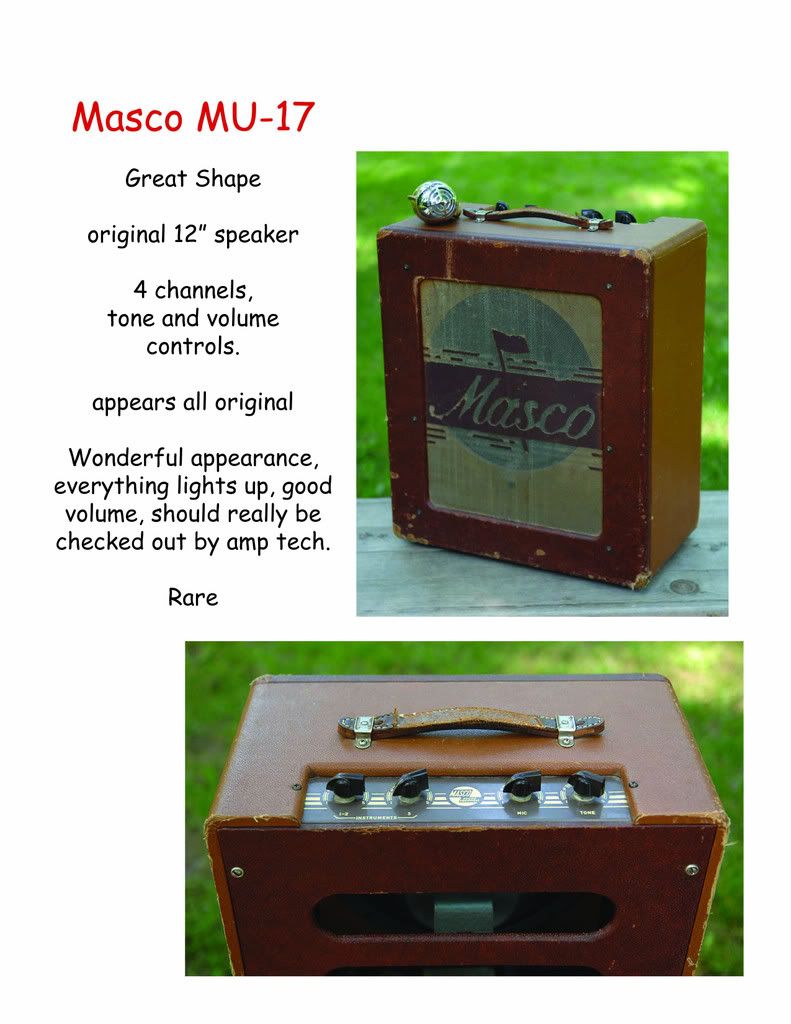
Masco Combo amp -"These rare combo amps rarely show up for sale. Mine has a fair amount of cosmetic "patina", cool look. The amp itself is really nice looking, no rust or corrosion. It works fine but is original, some pops and crackles, pots are a little scratchy, speaker seems fine. I would recommend a good amp tech. The guy here is one of the best in the midwest but takes a year to look at your stuff unless you're a rock star."

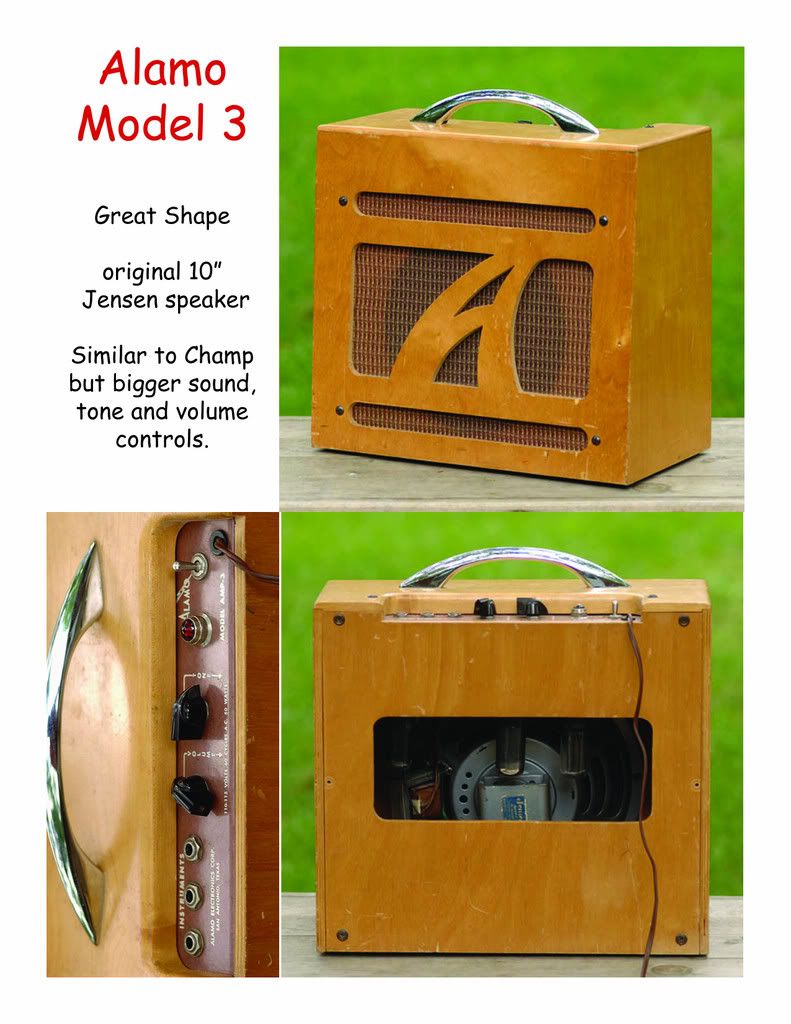
Alamo Model 3 -"This is the highly desirable wooden cabinet model, sounds terrific, rivals my Kendrick Champ,probably louder! Killer for harp! I have seen some really high prices for these on ebay in the last year. Exc. shape."

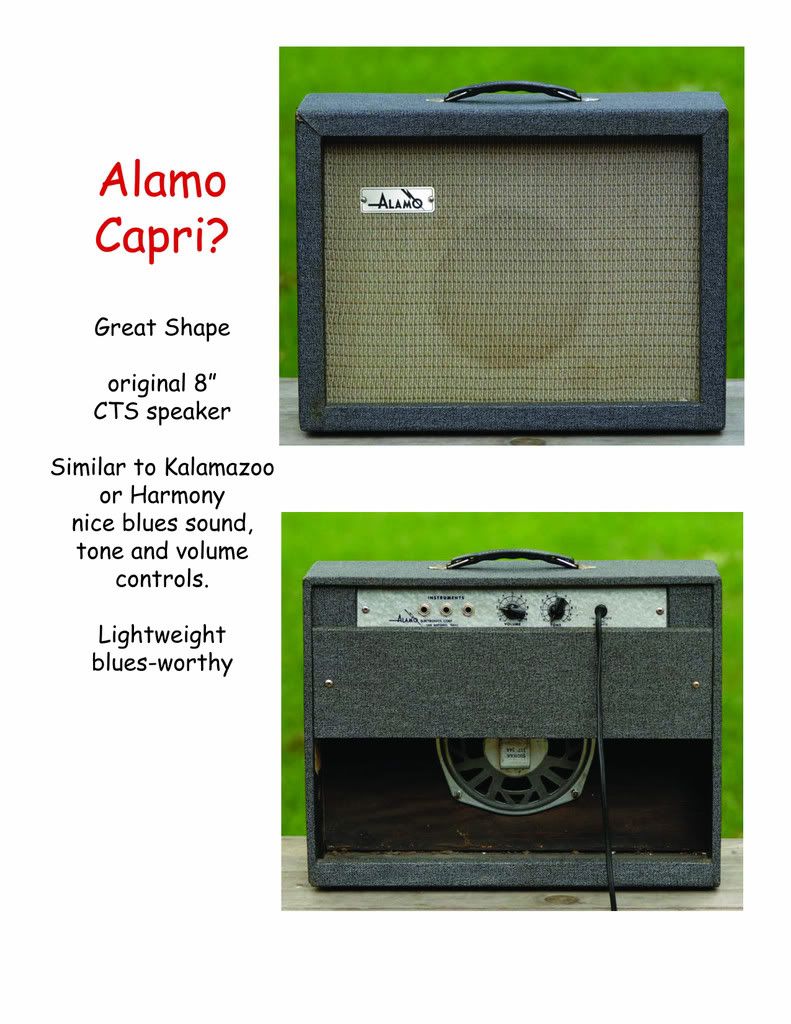
Alamo Capri -"Small practice amp in very nice cosmetic shape, sounds similar to a Harmony but i think a bigger sound, Alamo amps work well for harp."

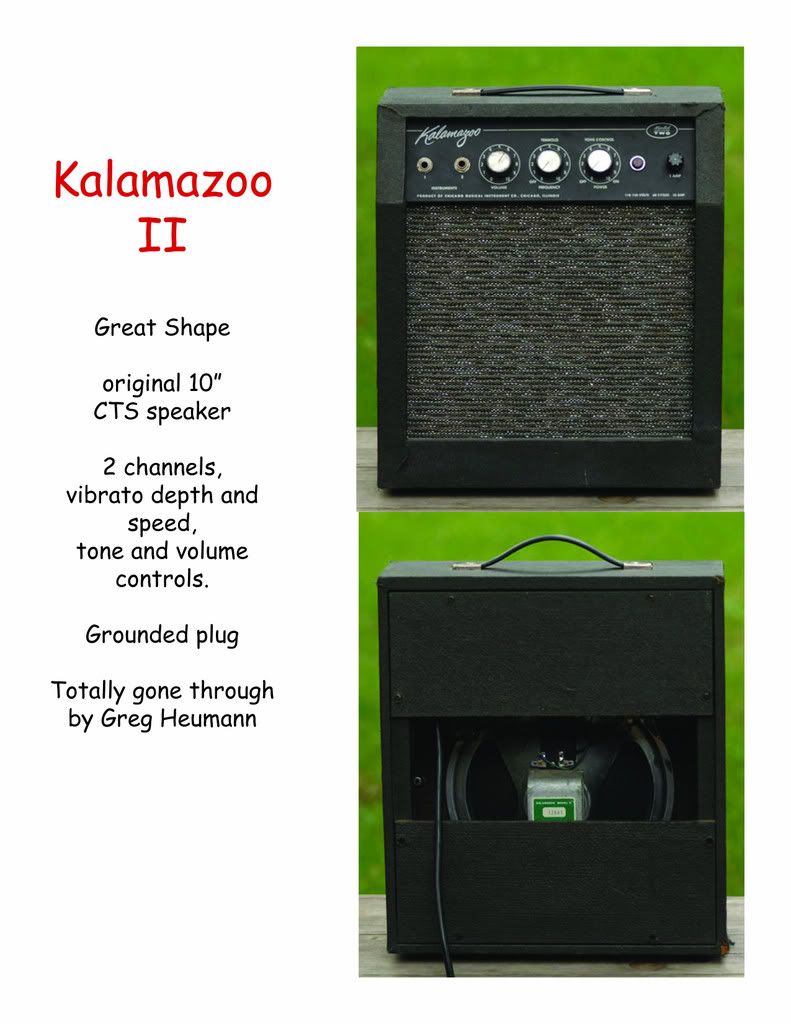
Kalamazoo II -"Greg Heumann went hrough this one, superb player, looks nice too."

Offers are invited for these collectible gems. Email rbeetsme@comcast.net.

[Dang! I might throw down an offer on a couple of those bad boys... -Rick]

Thursday, July 17, 2008

So Far, So Good


Since I started this blog back in March we have had over 16,000 page views, with the average visitor staying more than three minutes. Our readership grows every week. Not bad for a new, narrow special-interest blog, and people are returning again and again to read the articles. Most new visitors get here by searching Google for info on harp amps.

It is interesting that less than 60 percent of our visitors are from the United States. This blog has attracted visitors from over 40 different countries.

Plans for the future include more long-term hands-on reviews of harp amps in real-world situations. I’ve gotten commitments from some amp vendors and builders to loan me their gear for review, or to help me find an owner willing to share his gear. I’ve been in contact with several of the best harp players out there to discus gear and tone. More on that later.

Thank you for visiting my blog. Check back again as the quest for tone rolls on...

Wednesday, July 9, 2008

When Should You Amp Up?


It never fails. Every time a newbie inquires about amps on a harp forum, a crusty old harp veteran will fire back with the moldy cliché that Tone Comes From the Player, Not the Amp! This is invariably followed by other crusty old harp veterans who opine that said newbie should not even THINK about getting an amp until he has acquired good acoustic tone first.

To the first, I say “Duh!” To the second, I say “Nonsense!” Do these curmudgeons also get cranky with guys who buy certain sneakers, growling that the shoes won’t make them play like Michael Jordan? Thanks for illuminating the obvious, fellas.

If a new player (or any player for that matter) admires the tone he hears on recordings or at gigs, he will be curious about the rig the player used. However, no reasonable person would expect to instantly play harp like Jason Ricci after buying a HarpGear 50 amp. But there is nothing wrong with being inspired by the sound of the amp.

Harp players should never be discouraged from amping up. I put my students on the mic from the very first lesson. Every session ends with a few minutes of amplified playing and a brief discussion of amps and mics. Any harp player who has ever stepped up to a mic knows very well that bad harp playing sounds even worse when amped. Amps and mics are incentives to work harder and develop your tone; they are never a crutch for bad tone.

The notion that beginners should not start thinking about amps is absurd. Some crusty old veterans warn that new players might buy the “wrong” amp, or might over-buy. Maybe, but I haven’t seen many beginning harp players lugging boutique 4x10 amps to blues jams. And the decision about which amp is “right” for a player can only be made by the player himself after a lot of experience.

My advice to a new player interested in playing amped blues harp is to get a small tube amp and bullet mic right away. Practice with your rig every day. Before you know it, you will have developed your own tone.

Tuesday, July 8, 2008

Hurricane V8 harp amp on the market


Brian Purdy at HarpGear.com has a very interesting little amp for sale: a Hurricane V8.

I have a mint used Hurricane V8 amplifer for sale. This is the same model amplifier that Rock Bottom played exclusively in the last years of his playing. They have been discontinued for a few years now. It is in perfect condition with a D2F padded cover.
Here is a short demo of the Hurricane V8 amp in action, posted by a friend on YouTube. Nice tone.